

Noblis’ ADEPT® ADSSS is an advanced CBM solution with heritage in the U.S. Navy as AN/SYM-3(V) aboard Littoral Combat Ships. ADSSS unlocks remote monitoring by collecting health and operational data from critical systems and securely transmitting that data for analysis by systems such as Noblis’ Prognostics Framework® (PF). Its small footprint and extensible architecture mean it excels in a wide range of situations from small, remote equipment to complex, distributed systems. It uses an open architecture with industry-standard hardware and software protocols to ensure cybersecurity compliance, operational efficiency and data portability.
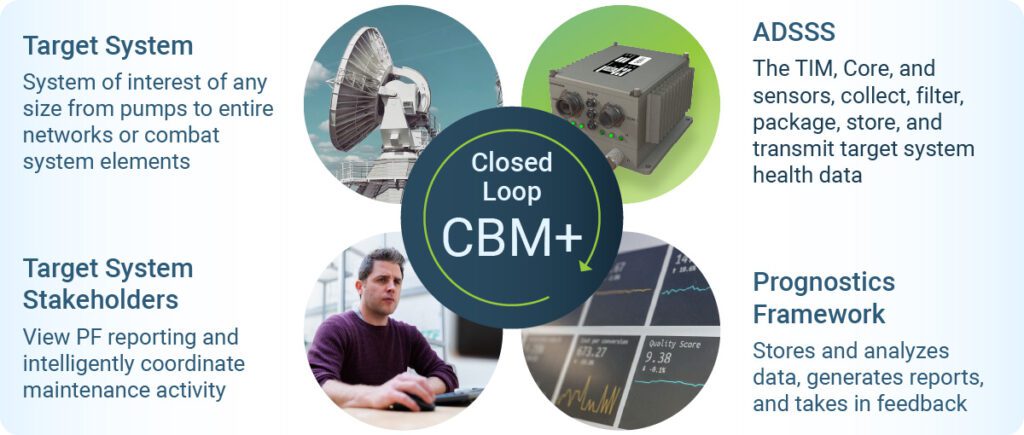
ADSSS is an evolution of Noblis’ preventative maintenance tools that began with ADEPT®. It automates capturing real-time system operational and health data, working unattended and with minimal maintenance. Its Target Interface Modules (TIMs) are universal data acquisition devices using industry-standard onboard interfaces and off-the-shelf sensors to monitor the target systems. The TIMs perform local triggering, filtering and compression to minimize data footprint, then transfer data to an ADSSS Core server. The Core aggregates, stores and sends the data to configurable on- or off-site destinations for analysis, such as Noblis’ PF. Data transfer can use existing, standard network infrastructure, including secure government links where available. The Core is the system’s gateway, providing an operator administration interface and sending alert notifications.
Features
|
Applications
|
Benefits
|
Open Architecture
ADSSS’s open architecture ensures interoperability, scalability, adaptability and data portability to streamline deployment and keep data in the hands of stakeholders who need it.
The TIM’s rugged, watertight enclosure houses industry-standard hardware in an internal bus formfactor, providing several common data interfaces with the option to add others if needed. Standard interfaces include Ethernet, RS-232/422/485 serial, secure USB and analog and digital I/O. Specialized interfaces, such as MIL‑STD‑1553, have already been added and proven in the field. The TIM’s interfaces support a variety of external sensors for additional data collection, such as air temperature and humidity, RF power measurements and power quality monitoring.
The software is designed using robust standards with maintainability in mind and to ensure data is never locked away in a proprietary format. The TIMs and Core, which run Java software in a Linux environment, communicate using the OMG data-distribution service (DDS®) protocol over standard network connections. Data collection is configured by a human-readable test script that can be updated without software changes. Collected data is then stored in human-readable eXtensible Markup Language (XML) files formatted per the IEEE SIMICA standard.
Alert Notifications
For urgent issues, ADSSS can send local alerts via email or other message systems to those who can respond on site. The Core server monitors configurable parameters and sends alerts when they fall out of tolerance.
Security
ADSSS is designed for cybersecurity compliance, even in DoD environments. Development processes and the software follow U.S. Government Security Technical Implementation Guides (STIG) and the software includes mechanisms to apply regular security updates to the distributed TIMs.
The TIMs can operate under strict security requirements common in critical applications, such as monitoring combat system elements. Both the hardware and software are designed to minimize or eliminate target system interaction through passive monitoring techniques. The system’s small network footprint can operate in restrictive environments, including the Total Ship Computing Environment (TSCE) and Consolidated Afloat Networks and Enterprise Services (CANES) networks on U.S. Navy vessels.
Data Analysis
ADSSS delivers the PLUS in CBM+ systems. It pairs seamlessly with Noblis’ PF analytics software to provide accurate, powerful condition assessment. PF can be collocated on-site with the ADSSS Core for real-time prognostics, diagnostics and status monitoring; or it can be installed off-site for remote monitoring by personnel and to aggregate data from multiple sites with ADSSS.
Quality
 Noblis is ISO 9001:2015 compliant and is certified under NAVSEA Technical Specification 9090-310F, Appendix C and NAVSEA Standard Item 009-04. Our quality management system ensures our software and hardware meet our clients’ requirements and remain reliable and secure.