

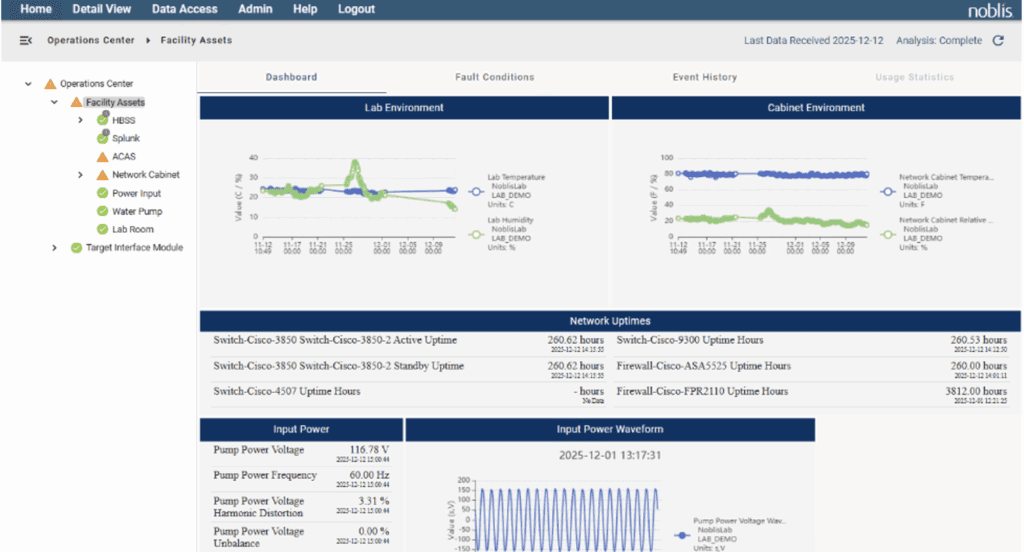
The Noblis PF® is a diagnostics and prognostics solution to monitor the health of critical systems and enable CBM. It is an agnostic platform that ingests data from a variety of sources, including Noblis’ Adaptive Diagnostic Electronic Portable Testset (ADEPT®) Distance Support Sensor Suite (ADSSS) data acquisition solution, and processes the data using analysis models following definable rules and algorithms. Stakeholders can use our PF’s interactive web interface to learn about the status of their systems by viewing data in flexible, configurable data graphs, and the software can alert users to active or predicted faults. PF is designed to scale with customer needs, and even for complex, distributed systems, it uses hierarchical trees and thoughtful page designs to ensure important information is discoverable and visible when needed most.
Features
|
Applications
|
PF is a network-enabled solution that can be hosted on any bare metal or virtualized server, whether on premise or in the cloud. Its Analysis Engine (AE) can run on any platform that supports the Java Runtime Environment, and its historian is compatible with standard SQL databases either provided as part of PF or that already exist in the customer environment.
The AE processes data using highly adaptable analysis models that can be modified with changing customer needs. The models can perform virtually any filtering and analysis operations on data — even on derivative data calculated by the model itself. If monitored systems change or if maintainers’ needs change, the models can be updated and expanded to suit those changes.
Unlike simple historians, PF is designed to robustly handle large volumes of heterogenous data that may not always be available in a steady stream, for example, from complex systems of systems deployed in remote environments with intermittent connectivity. From simple sensor measurements to complex built-in test (BIT) data and text logs, PF’s models can process them following definable rules. Results from data received in bursts or out of order are calculated just as though the data were received in real time, so aggregating data from remote, distributed locations is not a problem. Models can even reference data across multiple sources, enabling powerful analyses and trending across fleets of resources.
Benefits
|
Holistic Approach
|
Conditions Assessment
Noblis’ PF analyzes all provided data according to the analysis models, assessing system health and condition with the main goals to:
- Detect past and current faults
- Predict upcoming faults
- Arm maintainers with the information to isolate, troubleshoot and correct faults
- Track real component usage to compare against expected service life
Condition assessments are structured and presented in context to help stakeholders make informed decisions. System components down to the lowest/line replaceable units (LRU) are rendered in a tree with status indicators that can rank fault severity to highlight items needing critical attention. Faults are displayed with contextual data so that maintainers can quickly assess root causes and effectively position repair resources.
Analysis models are designed to incorporate subject matter expertise when simple go/no-go data is insufficient. Inputs like system modes and states can influence how data is calculated and analyzed, and component usage can be derated when operating in demanding environments such as high temperature or under heavy load.
On or Off Site, On- or Off-line
Different systems rely on support staff in different locations, and PF is portable and self-contained so it can be installed where needed. Install it on a local computer for hands-on troubleshooting or install it on the other side of the globe for remote, centralized monitoring of moving, dispersed assets.
Because not every monitored system has constant, reliable internet connectivity, PF handles data no matter when or how it is received. Streaming data will give the most near-real-time condition assessments. The historian will all the same take in data received days or even weeks after the fact, and the AE will revise its assessments based on that new information.
Practical Approach and Experience
PF boasts a heritage deployed with the U.S. Navy, and it has been used for monitoring the condition of systems ranging from building HVAC to complex and critical navigation radars and computer networks. Its flexible and agnostic approach to data storage and analysis means it can process anything from simple numerical data to multidimensional waveform data and text.
PF is a powerful tool for monitoring distributed and remote systems. Whether maintaining dozens of buildings’ mechanical systems or hundreds of remote air traffic beacons, PF puts their data and health in the hands of those who need it.